Dragon fruit e-liquid, from the taste of pitaya to DIY mixing
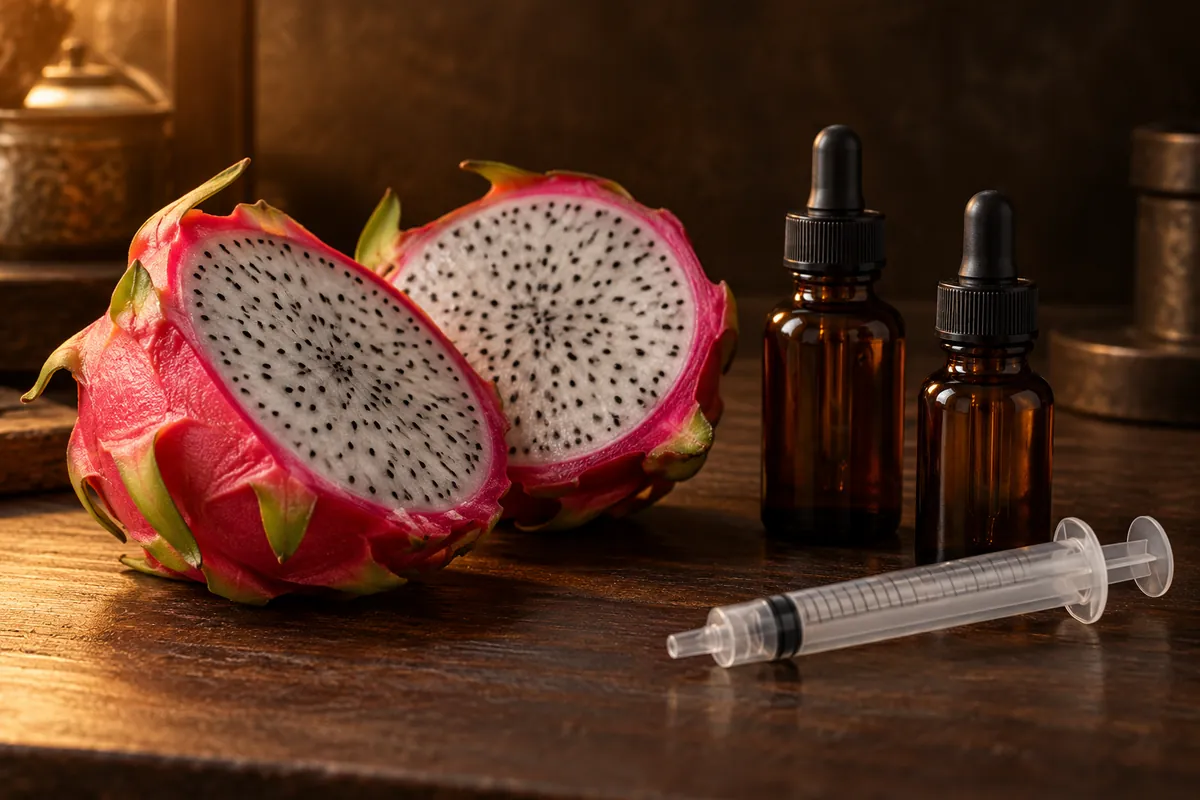
Bright pink outside, white and freckled with black seeds inside, the pitaya has everything it needs to catch the eye. On the tongue, though, it is one of the quietest fruits in the exotic aisle. A dragon fruit e-liquid has to work around that contradiction, which explains the range of bottles on sale and the gaps in mixing rates between concentrates. Before you pick a ready-made liquid or reach for a syringe, it helps to know what this fruit can really bring to a vape.
What to expect from a dragon fruit e-liquid
A dragon fruit e-liquid gives a soft, low-acid and lightly sweet flavour, without the punch of strawberry or mango. That is why most commercial recipes pair it with a second fruit or a cooling note.
In DIY, the concentrate is mixed at anywhere from 5 to 15% in a 50/50 base depending on the brand, and the steep times quoted run from zero to five days. The right figure is therefore the one on the sheet for the bottle in your hand, never a generic rate.
A quiet fruit, hence the pairings
Dragon fruit grows on cactus plants native to Mexico and Central America. Its watery flesh carries a light flavour that flavourists often need to prop up.
White flesh or red flesh
The most common pitaya, pink-skinned with white flesh, has a mild taste often likened to kiwi without the sharpness, or to pear. Red and purple-fleshed varieties are reputed to be more fragrant.
A concentrate therefore does not reproduce “the” dragon fruit. It reproduces one reading of it, sweeter or greener depending on the maker, so two bottles with the same name can end up far apart.
The pairings you see most often
Among the bottles that rank for the term, the same combinations keep coming back:
- strawberry, cherry, raspberry or mixed berries, to give the fruit some lift;
- lychee, pineapple or passion fruit, to stay in tropical territory;
- an “ice” or “slush” version, which adds a cooling agent.
The same logic applies to blended concentrates. Bloody Shigeri, for instance, swaps the kiwi for dragon fruit in the recipe covered in our piece on the Fighter Fuel Shigeri mixing rate.
Reading the label on a dragon fruit e-liquid
Beyond the fruit’s name, three details decide what you will actually vape.
The first is the flavour list. “Dragon fruit” on its own means a single-flavour liquid, which will be subtle by nature. A second fruit in the name signals a blend, where the pitaya usually plays the background role.
The second is the word “ice”, “slush” or “cool”. It points to a cooling agent that quickly drowns out such a light fruit. If you want to taste the fruit itself, skip those versions for a first try.
The third is the format. In the UK, nicotine-containing e-liquid is capped at 20 mg/ml and sold in bottles of 10 ml at most, and a refillable tank cannot hold more than 2 ml. Nic salt liquids in 10 ml bottles are common in this flavour.
Larger bottles are nicotine-free shortfills, filled short so that a nic shot fits in. A 50 ml shortfill in a 70 ml bottle with one 10 ml shot at 20 mg/ml comes out at roughly 3.3 mg/ml, and with two shots at roughly 5.7 mg/ml. Read the hazard statements as well. The dragon fruit shortfill in the Edition Natural range of French maker Curieux, for example, carries statement H317, which flags a risk of skin allergy on contact.
Check the PG/VG ratio too, since many shortfills lean heavily on vegetable glycerine. The base changes how the flavour comes through, as our guide to choosing a DIY base and its PG/VG ratio explains.
Mixing your own dragon fruit e-liquid
DIY lets you set the strength of a dragon fruit e-liquid yourself, which matters for such a quiet fruit. You still need the right starting rate, and concentrate makers do not agree on it.
Three sheets, three mixing rates
Here is what three 10 ml dragon fruit concentrates made in France publish on their product sheets.
| Concentrate | Rate quoted | Drops per 10 ml | Steep quoted |
|---|---|---|---|
| Arômes et Liquides | from 5% at 50/50 | 25 | 48 to 72 hours |
| Solubarome | 15% at 50/50 (10% at 70/30, 20% at 30/70) | 45 at 50/50 | 0 to 5 days |
| Solana | 5 to 10%, ratio not stated | not stated | not stated |
Between 5 and 15%, the amount of concentrate triples, because each maker concentrates its flavouring in its own way. A rate lifted from one sheet and applied to another bottle gives a mix that is either flat or saturated.
Drops do not convert from one brand to another
The two drop conversions in the table do not match. On the first sheet, 25 drops stand for 0.5 ml, which is 50 drops per millilitre. On the second, 45 drops stand for 1.5 ml, which is 30 drops per millilitre.
The size of a drop depends on the tip and on the viscosity of the liquid. A graduated syringe avoids the trap whatever the bottle.
The sums for 30 ml
The sum is always worked on the final volume, concentrate included. In a nicotine-free 50/50 base:
- at 5%, 1.5 ml of concentrate and 28.5 ml of base;
- at 15%, 4.5 ml of concentrate and 25.5 ml of base.
For 30 ml at 3 mg/ml you need 90 mg of nicotine, which is 4.5 ml of nic shot at 20 mg/ml. The shot comes out of the base, never out of the concentrate. At 15%, the recipe becomes 4.5 ml of concentrate, 4.5 ml of shot and 21 ml of base.
How long to steep a dragon fruit e-liquid
Light fruit flavours generally need less steeping than dessert recipes. The two sheets in the table that give a duration both keep it short, 48 to 72 hours for one and zero to five days for the other.
Taste a first 10 ml batch after two days, then again at around five days. If nothing changes between the two, there is no point waiting longer. A dragon fruit mix that still tastes hollow at five days is short of concentrate rather than of steeping time, and one extra point at a time puts it right.
Pairing dragon fruit with another concentrate
To recreate the blends sold in shops in a home-made dragon fruit e-liquid, add a second fruit rather than pushing the pitaya rate up. Each concentrate takes its share of the flavour volume, so start at two thirds of each sheet’s rate and adjust on 10 ml. A red berry or a citrus note quickly takes over from pitaya. Keep it in the background on the first batch.
FAQ
These questions come up again and again in searches about dragon fruit. Here are the answers that matter when you pick it as an e-liquid.
Why is pitaya called dragon fruit?
The name comes from the look of its skin, brightly coloured and covered in scales that call a dragon to mind. Pitaya, or pitahaya, is its Latin American name, and makers use the two words interchangeably.
What plant does dragon fruit grow on?
Not a tree but a climbing cactus of the genus Selenicereus, long classified as Hylocereus. It clings to neighbouring trees and can climb several metres.
Why is dragon fruit pink?
The colour comes from betacyanins, pigments from the same family as the betanin in beetroot. A dragon fruit e-liquid owes nothing to those pigments, and its colour says nothing about its taste.
What does a dragon fruit e-liquid smell like?
The fresh fruit has little smell. In a bottle, the scent you notice on opening comes mostly from the second fruit or the cooling agent, and it only partly predicts the taste once vaped.
What is the best dragon fruit e-liquid?
No bottle is best in absolute terms. To taste the fruit, choose a single-flavour liquid with no “ice” on the label. For a bolder flavour, a blend with a red berry or another tropical fruit suits better.
Dragon fruit e-liquid, a quiet fruit that rewards method
Dragon fruit appeals through its softness, but its subtlety forces some choices. On a ready-made bottle, look at the second fruit and the word “ice” before the pitaya itself. In DIY, follow the sheet for your own concentrate, between 5 and 15% depending on the brand, and measure with a syringe.
Those habits hold for the whole fruit family. They let you judge a dragon fruit e-liquid on what is really inside it, rather than on the colour of the fruit printed on the label.
Related reading
- Fighter Fuel Shigeri concentrate, mixing rate and steep time
- Hazelnut flavour concentrate, rate and steeping time
- DIY kit, what the concentrate inside really contains
Editorial content for adult readers only. Vaping products can contain nicotine, which is a highly addictive substance, and vaping products are not for sale to anyone under 18 in the UK. This article is not a buying recommendation.
Read next
Hazelnut flavour concentrate: rate and steeping time
The same hazelnut flavour concentrate is listed from 7 to 20 per cent in Britain. Where the gap comes from, which rate to take and how long to steep.
Ragnarok Zero, reading the red berry profile on the label
Ragnarok Zero by A&L, the red berries listed, the four molecules declared on the label and what the Zero name removes, before you mix it.
Geekvape Soul 2, the pod kit specs and the e-liquid to use
Geekvape Soul 2 specs (2100 mAh, 35 W, 0.6 and 1.0 ohm pods) and the e-liquid to use, PG/VG ratio, nic salt or freebase and DIY mixing.