DIY kit: what the concentrate inside really contains
A DIY kit promises to take the arithmetic out of mixing, but it rarely says what is actually in the flavour bottle it hands you. Base, nic shots and concentrate arrive together, with the aroma composition summarised in a single commercial name on the box. That composition is what decides the finished taste, the rate you have to respect and how long you wait before vaping it.
What is really in a DIY kit
A DIY kit gathers three distinct things: an unflavoured base in a stated PG and VG ratio, one or more nic shots, and a bottle of concentrate already sized for the finished volume printed on the box. Only the concentrate determines the flavour profile.
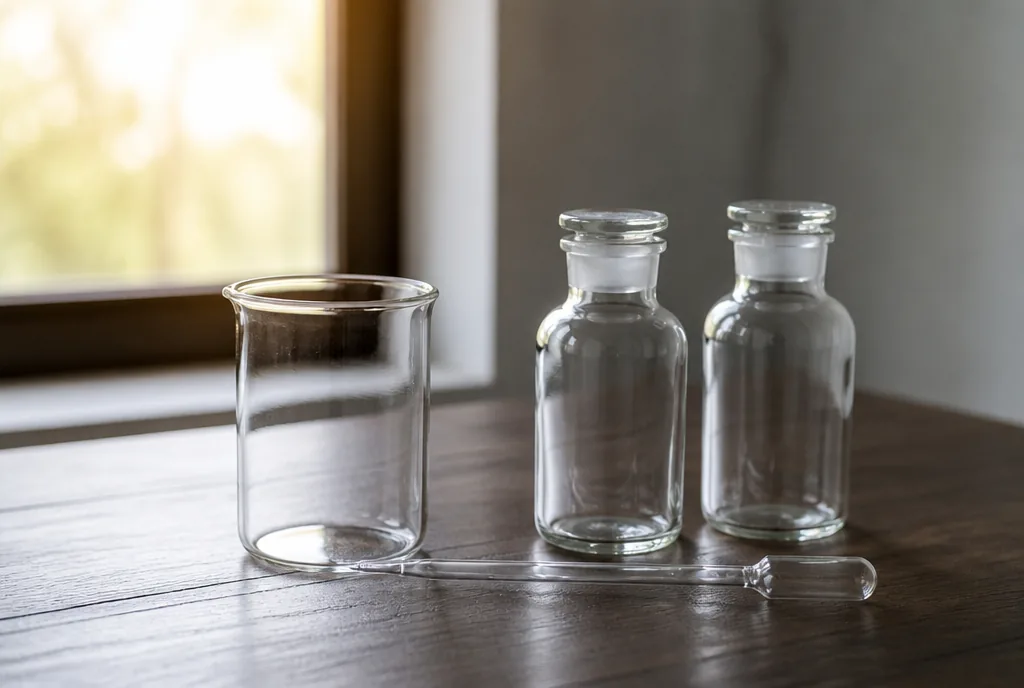
British listings are reasonably transparent about the hardware side. A typical bundle sold here contains base liquid, nic shots, one or more flavour concentrates and an empty bottle sized for the whole mix, often 100 or 150 ml. The larger bundles add the tools, meaning syringes, pipettes, spare bottles and a pair of gloves.
Entry level kits generally supply several small concentrates rather than one large bottle, commonly four 10 ml flavours, while the step up moves to 30 ml bottles. That difference matters more than it looks: small bottles are for trying profiles, large ones are for repeating a recipe you already like.
Why the concentrate choice is usually conservative
Most kits sold in shops rely on a single flavour concentrate or a simple assembly of two or three notes. A fruit kit rarely carries more than two dominant fruits, and a dessert kit usually pairs a sweet base with one fatty note such as cream, biscuit or caramel.
That simplicity is not a defect. It limits the risk of imbalance on a first attempt, which is exactly the opposite of buying several concentrates separately and discovering that each addition shifts the balance of the one before it.
It does have a cost. A fixed assembly leaves you no room to move a single note, so a kit that is almost right is a kit you cannot quite fix without buying a fourth bottle.
How the concentrates in a DIY kit are dosed
The flavour rate in a DIY kit is set in advance by the maker, based on the PG and VG ratio of the base included in the box. It is not always printed as a percentage on the label, sometimes appearing instead as a number of drops or a volume to pour in.
That figure varies with the family of the concentrate. Menthol and classic tobacco profiles often stay effective at a low rate, in the region of eight to twelve per cent, while a complex dessert or a multi note fruit frequently wants fifteen to eighteen per cent before it opens up at all.
Our guide to the DIY base explains why the same concentrate changes character with the ratio. A kit built on a 50/50 and a kit built on a 70/30 do not deliver the same thing, even with a strictly identical bottle of flavouring in the box.
The nic shots that come in the box
When a kit includes nic shots, the handling calls for the same simple precautions every time. Gloves on to avoid skin contact, bottles kept out of reach of children and animals, and the whole set stored away from light and away from heat.
The strength is worked out on the total volume of the preparation, base and shots included, never on the base alone. Nicotine containing liquid is capped at 20 mg per ml and refill bottles at 10 ml in the United Kingdom, so a single shot carries at most 200 mg. Divide that total by your finished volume and you have your answer, whatever it comes to.
Each maker publishes its own calculation table for its own bundle. Follow the one that came with the box rather than a figure remembered from a different kit, because the base volume and the bottle size are rarely the same twice.
How long to steep, by flavour family
The rest a DIY kit needs depends directly on the family of the concentrate supplied, not only on the ratio of the base. That variable is often missing from the instructions, even though it governs the result more than anything else in the box.
Fresh and menthol families stabilise quickly. Two to four days is generally enough, because the volatile molecules diffuse fast through the base, and British steeping guides routinely put menthol and tobacco style flavours at the short end of the scale.
Fruit families ask for a little more patience, around a week, while the acidic notes round off without losing their edge. Dessert and bakery families go further still: ten days to a month is common advice here for custard, cream and nut profiles, and rushing them is the usual reason a kit disappoints.
Tasting a dessert kit too early gives an impression of aromatic fog, with one note too far forward and the others barely present. That is not a fault in the kit, only an insufficient rest.
Judging a DIY kit on its composition
The quality of a DIY kit is not written on the packaging. It sits in three concrete pieces of information that a product page either publishes or does not: the components of the concentrate, the recommended flavour rate, and the traceability of the maker.
A serious bundle names the brand of the concentrate it contains, not just an invented name for the kit itself. That single line lets you look up the real safety sheet and the real dosing guidance from the house that formulated it, which is almost always more precise than the generic leaflet stapled to the box.
Four checks cover the rest. Look for a detailed composition or an identifiable concentrate brand, a rate expressed as a percentage rather than only in drops, a base ratio coherent with the profile of the flavour, and a manufacturing or durability date printed on the bottle rather than the outer box.
A badly dosed concentrate inside a bundle shows up later, at the tasting: flat despite a proper steep, or saturated from the first puff. In both cases the origin is nearly always the rate fixed by the maker, not a mistake at your bench.
Comparing a concentrate sold on its own, such as the Red Astaire concentrate, against its equivalent inside a bundle is the quickest way to measure that gap. The standalone bottle publishes a range you can move within, while the kit translates that range into one fixed quantity that may or may not match your palate.
Simple profiles tolerate a fixed rate best, because their balance rests on very few notes. Complex desserts and multi note assemblies, of the kind discussed in our piece on the cotton candy flavour concentrate, gain far more from being adjusted by hand once the kit itself holds no surprises.
Frequently asked questions
Is a DIY kit suitable for a complete beginner?
Yes, and that is its main advantage: the rate is already calculated and there is no ratio arithmetic to do yourself. The remaining margin for error is essentially whether you respect the steep.
Can I swap the supplied concentrate for another flavour?
Technically yes, but the rate printed on the box stops being valid the moment you do. You then need to work from the dosing guidance published for the new concentrate instead.
Why do two kits with the same flavour name taste different?
The concentrate brand often changes from one bundle to the next even when the flavour name is identical. The exact composition and the rate fixed by the maker explain the difference in what reaches your mouth.
Should I shake a mix while it steeps?
A light daily shake helps homogenisation, particularly on glycerine heavy bases. It is not compulsory, though it often shortens the wait you actually perceive.
Is an out of date bundle still usable?
The base and the concentrate each carry their own durability date, and they are usually different. A concentrate that has darkened or lost its characteristic smell should be set aside even if the base looks intact.
Choose a bundle on its contents, not its box
A DIY kit is not simply a shortcut past the dosing calculation. Its real value lies in the quality of the concentrate inside, in the coherence between the quoted flavour rate and the family that concentrate belongs to, and in respecting the steep that family needs.
Checking those three points before you buy avoids the disappointment of a ready made bundle that turns out unbalanced. That careful reading of the composition remains the best guarantee available, well ahead of the packaging or the name on the front of a DIY kit. Once the habit is in place it works just as well on a bundle as on a mix you assemble yourself from separate bottles, including a cool profile such as the Heisenberg concentrate.
Editorial content for adult readers only. Vaping products usually contain nicotine, a substance that causes addiction. Not for sale to under-18s in the United Kingdom. This article is not a buying recommendation.
Read next
Red Astaire concentrate: dosing and steeping in DIY
The Red Astaire concentrate is listed from 15 to 20 per cent. Dilution figures, the steep time that holds up and the bench mistakes to avoid.
Heisenberg concentrate: mixing rate and steep time
Heisenberg concentrate: 15 to 20 per cent depending on the source, 1 to 7 days of steeping. Mixing rates, steep windows and storage that hold up.
DIY base: choosing your PG/VG ratio and mixing rate
Your DIY base decides your flavour rate and your steep time. PG/VG ratios, nic shot arithmetic and the mixing mistakes that cost a whole bottle.